About
I’ve spent the last 45 years as a master technician in Santa Cruz. For 23 of those years, I’ve owned and operated Mid County Auto Center, where I specialize in Honda and Acura repair and maintenance. We’ve seen loads of changes over the decades. And while cars are evolving, our environment is changing too.
Where can the rodents go as the civilized world expands?
They have moved into our cars!
Mark Jackson
Mark Jackson, Founder & Rat-ologist
Coda, Rat-Sniffing Dog
Free-loaders Under Your Hood
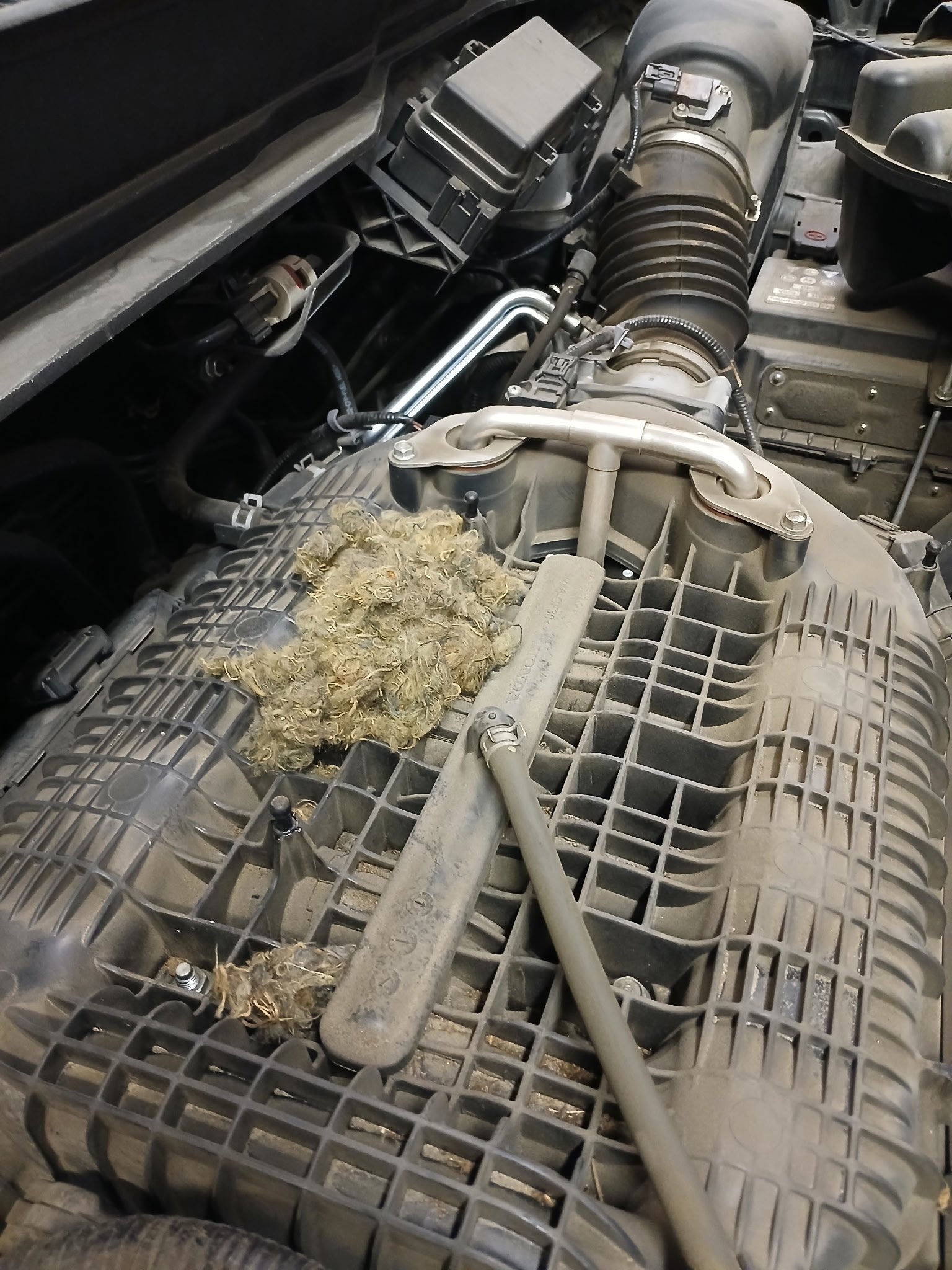
About 8 out of every 10 cars that roll into my shop for repair have a resident rodent. It’s become rare for me to pop a hood and not see an engine covered in droppings. It’s messy, it’s destructive, and it’s a major health hazard. In comes Keep em Out!
Our Battle Plan
I’ve spent a lot of time studying these guys. They’re pesky and surprisingly smart, so I came up with a "battle plan" to hit them from every angle:
1. The Keep ‘em Out! Cabin Air Filter
The cabin filter is a rodent's favorite nesting spot. Since your HVAC system pulls the air you breathe directly through this filter, a nest there isn't just gross—it’s dangerous. It can expose you to things like Hantavirus and other serious respiratory issues.
We developed a first-of-its-kind air filter specifically designed to block and prevent nesting. It’s the heart of our system: it keeps the critters out and the air you breathe clean.
2. Automobile Defense Services
You can't just shoo them away; you have to clean, reclaim, and repel. We bring the shop to you with a full suite of pest protection options:
Deep Steam Cleaning: We use a special formula of peppermint degreaser to sanitize the area. This is crucial for removing the pheromones and droppings they leave behind.
“Keep em Out!” Barriers: We install custom grills and filters to block the physical entry points rodents use to get inside.
"Stuff Bags": These are our signature scented packets designed to protect your firewall. We use a responsible, effective blend of tea tree and peppermint oils that smells great to us, but sends rodents packing.
Full Automobile Protection: From vehicle encapsulation and professional trapping to monthly or bi-monthly mobile prevention visits, we stay on top of the problem so you don't have to.
At the end of the day, we’re here to make sure your car stays a vehicle, not a hotel for critters.
We’re here to make sure your car stays a vehicle, not a campsite for critters.
Contact us
Call for an appointment in the Santa Cruz area or send us an email using this form.
The History of Rodents in Civilization
Rodents have lived alongside human civilization for thousands of years. As agriculture developed in early settlements such as those of Mesopotamia and Ancient Egypt, stored grain created stable food sources for mice and rats. Their ability to reproduce rapidly and adapt to human-built environments allowed them to spread with trade routes and maritime travel. By the time of the Roman Empire and later medieval European cities, rats were firmly established in urban centers.
Rodents have influenced public health history. The black rat, transported along trade networks, played a role in the spread of plague during the 14th century. In growing industrial cities of the 18th and 19th centuries, expanding sewer systems and dense housing provided ideal nesting and feeding conditions. Today, the most common commensal species in North America—the house mouse , Norway rat , and roof rat —continue to thrive in close proximity to people.
Historically, natural predators helped limit rodent populations. Domestic cats became common in agricultural societies for this reason. However, predator balance varies by region. In the Santa Cruz area, particularly in woodland-adjacent neighborhoods, coyotes are well established. Coyotes prey on small mammals but also reduce the number of free-roaming domestic cats. As a result, outdoor cat populations are often lower in these areas than in urban centers without significant coyote presence. With fewer roaming cats, rodents may encounter less routine predation pressure immediately around homes.
Rodent control in modern communities therefore relies less on natural predators and more on exclusion, sanitation, and structural prevention. Sealing entry points, removing food sources, and maintaining vegetation setbacks are more reliable long-term strategies than depending on predator presence alone.
We’re here to help you Keep em Out!